Physics Gravitation JEE Syllabus
 Avisha Das18 Jun, 2026
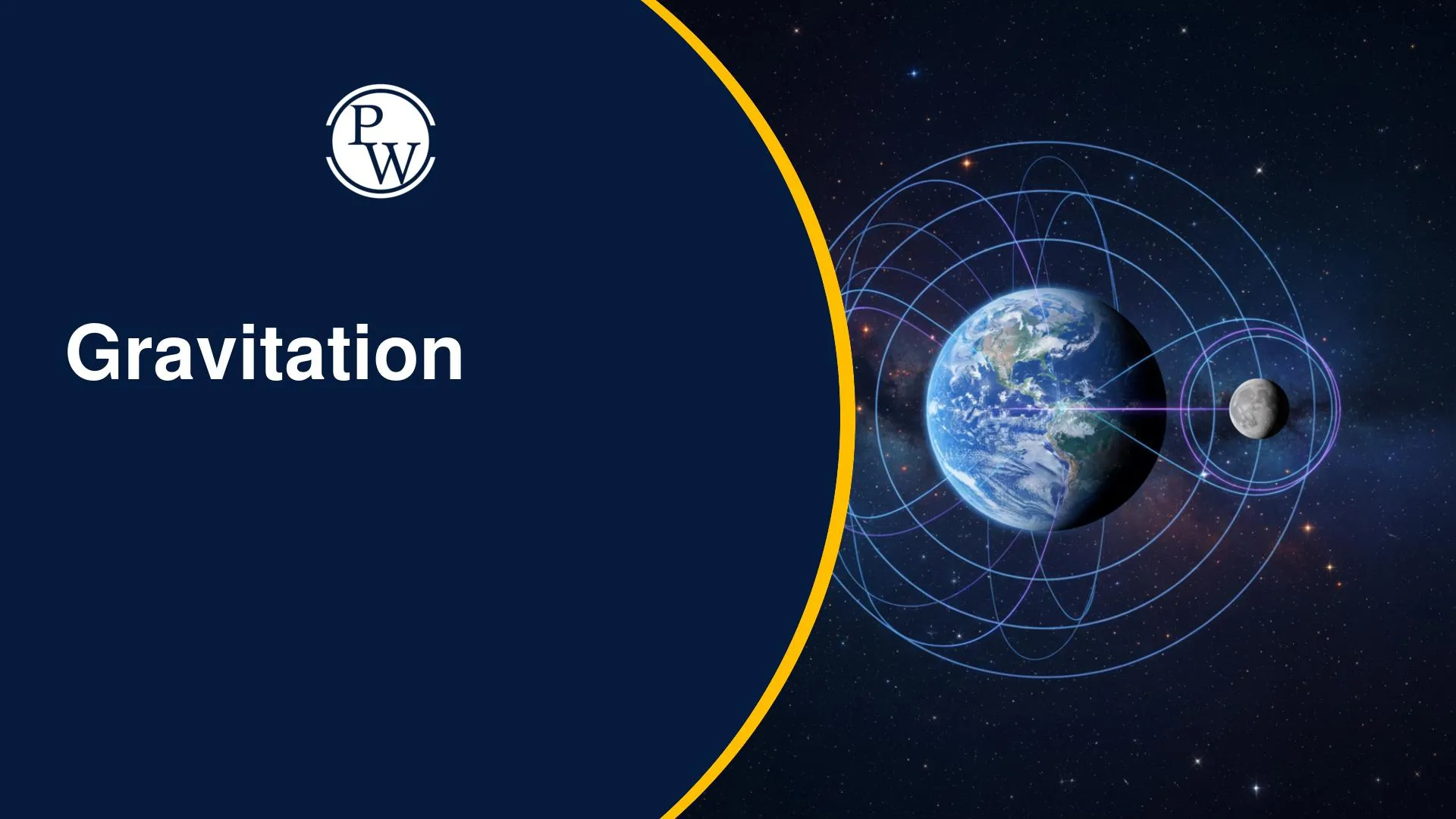
Why do planets stay in orbit instead of drifting away or falling into each other? Why does a thrown object always return to Earth? Gravitation explains this through a universal attractive force acting between all masses. It builds a single framework for motion under gravity using inverse-square force, energy concepts, and field ideas. It connects falling bodies with satellites and planetary motion. Key topics include Kepler’s laws, Newton’s law of gravitation, gravitational field and potential, variation of g with height and depth, escape velocity, and satellite motion.
From an exam point of view, this chapter is very important because problems often combine multiple concepts like energy, circular motion, and gravity in one question. It tests understanding, not memorisation. A strong grasp here also supports mechanics, helping in topics like energy conservation, rotational motion, and orbital dynamics.
Introduction and Kepler's Laws of Planetary Motion
Gravitation is a fundamental attractive force that acts between all masses in the universe. Kepler's laws describe the empirical orbits of planets and satellites, providing the observational foundation for Newton's gravitational laws.
Orbital Ellipses and Periodicity Scales
Planets move in elliptical orbits with the sun sitting at one focus. Their orbital parameters follow strict geometric and structural conservation laws that apply across all planetary systems.
Kepler’s First Law (Law of Orbits): Every planet moves in an elliptical path around the sun, with the sun located at one of the two focal points (foci) of the ellipse.
Kepler’s Second Law (Law of Areas): The radius vector drawn from the sun to any planet sweeps out equal areas in equal intervals of time. This uniform areal velocity directly implies that angular momentum is perfectly conserved under central forces:
Areal Velocity (dA/dt) = L / (2m) = Constant
Kepler’s Third Law (Law of Periods): The square of the time period (T) of revolution of a planet is directly proportional to the cube of the semi-major axis (a) of its elliptical path:
T² ∝ a³ ⇒ T² / a³ = Constant
Newton's Universal Law of Gravitation
Newton's law quantifies the attractive force between two point masses. It follows an inverse-square relationship and acts along the straight line connecting the centres of the masses.
Point Mass Attractions and Vector Superpositions
The gravitational force between two point particles is directly proportional to the product of their masses and inversely proportional to the square of the distance separating them.
Scalar and Vector Formulations:
F = G (m₁ m₂) / r²
F₁₂ = -G (m₁ m₂) / r² × r̂₂₁
(Where G ≈ 6.67 × 10⁻¹¹ N·m²/kg² is the Universal Gravitational Constant)
Principle of Superposition: The net gravitational force acting on a single mass due to a surrounding distribution of multiple independent masses equals the vector sum of the individual forces:
F_net = F₁ + F₂ + F₃ + ... + Fₙ
F_net = Σ (-G m mᵢ / rᵢ² × r̂ᵢ)
Shell Theorem Constraints (Crucial for JEE Problems):
• A uniform spherical shell attracts external point masses as if its entire mass were concentrated at its centre.
• The net gravitational force exerted by a uniform spherical shell on any point mass inside its hollow interior is exactly zero.
Gravitational Field Intensity
The gravitational field defines how a mass alters the spatial environment around it. It measures the gravitational force exerted per unit mass placed at a specific point in space.
Force Accelerations and Spherical Field Formulations
Gravitational field intensity (E or I) represents the acceleration a tiny test mass experiences when placed in a gravitational field.
Mathematical Definition:
E = F / m(test)
Field Intensity for Solid Uniform Spheres (Mass M, Radius R):
External Points (r ≥ R):
E(out) = GM / r²
Internal Points (r < R):
E(in) = GM r / R³
Field Intensity for Thin Uniform Shells (Mass M, Radius R):
External Points (r ≥ R):
E(out) = GM / r²
Internal Points (r < R):
E(in) = 0
Acceleration Due to Gravity (g) and Spatial Variances
The parameter g measures the local gravitational acceleration at the surface of a massive body like Earth. This value changes based on altitude, depth, and the rotation of the planet.
Altitude Shifts, Crustal Depths, and Rotational Bulges
Earth's acceleration due to gravity is calculated from its total mass (M_E) and radius (R_E). This baseline value decreases as you move above or below the surface.
Surface Value:
g₀ = G M_E / R_E² ≈ 9.8 m/s²
Variation with Altitude/Height (h above surface):
Exact Equation: g_h = g₀ (R_E / (R_E + h))²
Approximation (valid if h << R_E):
g_h ≈ g₀ (1 - 2h / R_E)
Variation with Depth (d below surface):
g_d = g₀ (1 - d / R_E)
[At Earth's core, d = R_E ⇒ g = 0]
Variation due to Earth's Rotation (latitude λ):
g_λ = g₀ - ω² R_E cos²λ
At Equator (λ = 0°): g is minimum
At Poles (λ = 90°): g is maximum
Gravitational Potential and Potential Energy (U)
Gravitational potential energy tracks the work required to assemble a system of masses against their mutual gravitational attraction. Because gravity is an attractive force, this potential energy is always negative.
Work Integrals and Scalar Gradient Fields
The potential energy of a two-mass system measures the work done by an external agent to bring the masses together from an infinite distance apart.
Gravitational Potential Energy (U): For two point masses separated by a distance r:
U = -GMm / r
Gravitational Potential (V): The potential energy per unit mass at a given point in a gravitational field:
V = U / m = -GM / r
Field-Potential Calculus Link: The field intensity vector equals the negative spatial gradient of the scalar potential:
E = -grad V = -dV/dr × r̂
Potential Inside a Solid Uniform Sphere (Highly Tested in JEE):
External Points (r ≥ R): V(out) = -GM / r
Internal Points (r < R): Forms a non-linear curve that reaches its deepest point at the centre:
V(in) = -GM (3R² - r²) / (2R³)
⇒ V(center) = 1.5 × V(surface) = -3GM / (2R)
Escape Velocity (ve)
Escape velocity is the minimum speed a particle requires to break free from a planet's gravitational pull and coast to an infinite distance away without any further propulsion.
Total Energy Thresholds and Launch Boundaries
To escape a gravitational field, a particle's total mechanical energy must be greater than or equal to zero. This boundary condition determines the required launch speed.
Energy Balance Equations:
E(surface) = K + U
= (1/2) m ve² - GMm / R = 0 (Energy at infinity)
Escape Velocity Formulations:
ve = √(2GM / R) = √(2gR)
Earth Constants: For Earth, substituting standard mass and radius values yields:
ve ≈ 11.2 km/s
Note: Escape velocity depends entirely on the mass and radius of the planet. It is completely independent of the mass of the launched projectile or its launch angle.
Satellite Mechanics and Orbital Profiles
Satellites in stable circular orbits balance the inward pull of gravity against the outward effects of their orbital speed. Their speed and period are determined entirely by their altitude.
Centripetal Balance and Energy Configurations
For a satellite of mass m circling a planet of mass M at an orbital radius r = R + h:
Orbital Velocity (vo): Calculated by balancing centripetal acceleration against the local gravitational force:
m vo² / r = GMm / r²
⇒ vo = √(GM / r) = √(GM / (R + h))
For a low-altitude orbit (h << R): vo ≈ √(gR) ≈ 7.92 km/s
Escape-to-Orbital Link: ve = √2 × vo (for low-altitude profiles)
Time Period of Orbit (T):
T = 2πr / vo = (2π r^(3/2)) / √(GM)
⇒ T² = (4π² / GM) r³ (Matches Kepler's 3rd Law)
Satellite Energy Matrix (Crucial for JEE Interchanges):
Energy Type | Mathematical Expression | Proportionality Relationship
Kinetic Energy (K) | (1/2) m vo² = GMm / (2r) | K = -E
Potential Energy (U) | -GMm / r | U = 2E
Total Energy (E) | K + U = -GMm / (2r) | E = (1/2)U
Binding Energy: The energy required to break a satellite out of its stable orbit and push it to infinity, which equals the absolute value of its total energy:
E(binding) = |E| = GMm / (2r)
Geostationary and Polar Satellites
Satellites can be placed into specialised orbits to achieve fixed positions relative to Earth's surface or provide full global coverage.
Synchronous Rotations and Synchronised Tracks
Geostationary satellites match Earth's rotation to stay parked over a single spot on the equator, while polar satellites cross the poles to scan the entire planet over time.
Geostationary (Synchronous) Satellites:
Orbital Period: Exactly matches Earth's rotation (T = 24 hours)
Direction of Motion: West to East, orbiting strictly within Earth's equatorial plane
Orbital Altitude: Must be parked at a precise height of approximately h ≈ 36,000 km (r ≈ 42,200 km from Earth's centre)
Primary Use: Telecommunications, global broadcasting, and continuous weather monitoring
Polar Satellites:
Orbital Geometry: Low-altitude orbits (h ≈ 500 - 800 km) that cross over the north and south poles
Orbital Period: Typically around 100 minutes
Primary Use: High-resolution remote sensing, environmental monitoring, and military surveillance
Because the satellite moves vertically while Earth rotates horizontally beneath it, it scans the entire surface of the globe piece by piece over successive passes.